We Build Custom AI Voice Agent and Dialer Platforms
Nexonalabs is a software agency that designs and builds AI voice agent platforms for call centers, insurance, home services and clinics. We built Valyrian Voice, a production platform running AI dial sessions at 100 lines, with AI calls from 1¢ a minute.
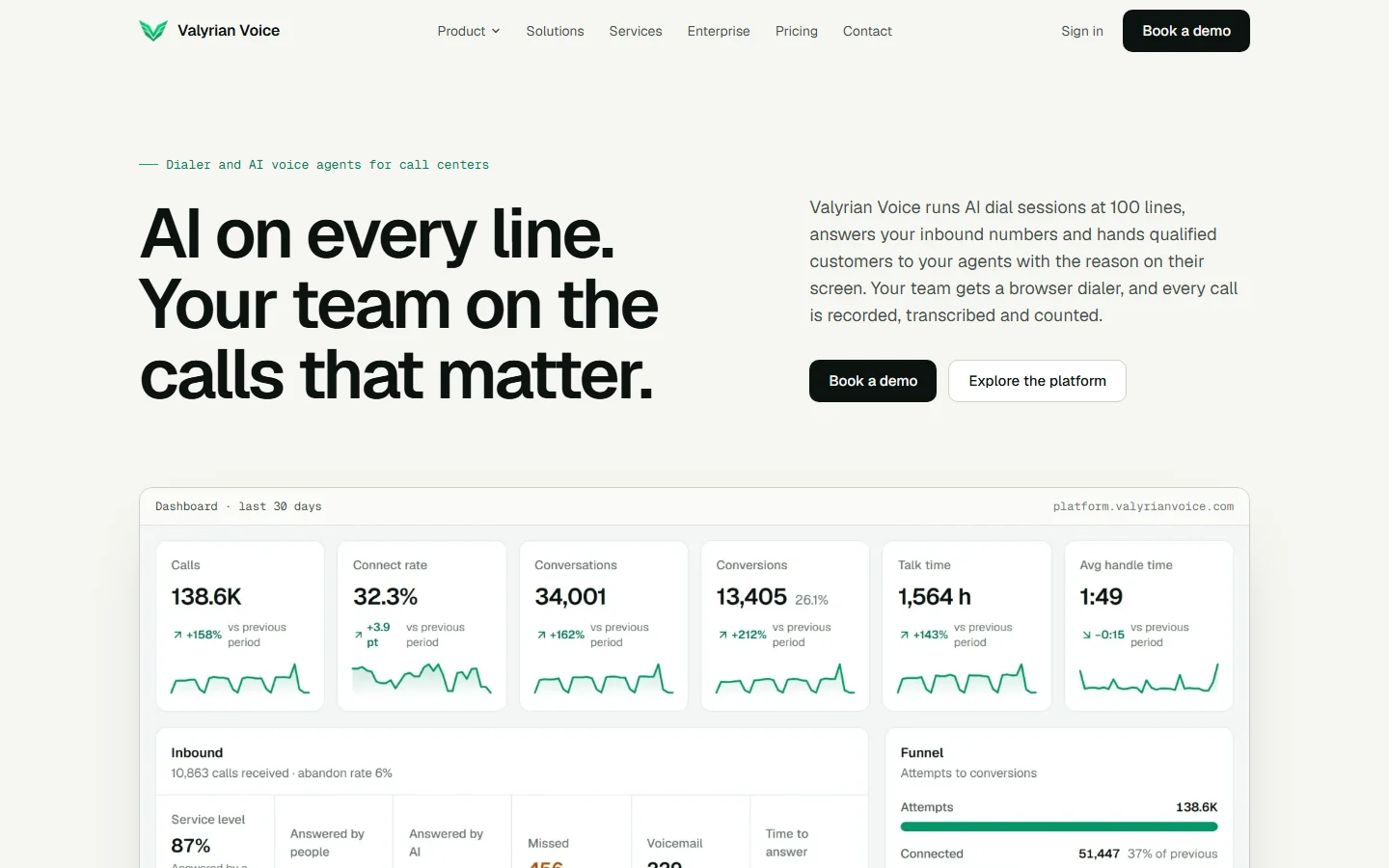
Valyrian Voice: dialer and AI voice agents for call centers
The problem
Call centers run on lists nobody finishes. Renewals pile up, leads go cold within hours, recalls end in voicemail. A faster dialer just reaches voicemail quicker, and more agents cost more. They needed AI on the lines, and their people kept for the calls worth having.
Stack and architecture
Audio comes in over SIP. Agents then run on either Gemini Live or a dedicated GPU pipeline, where speech recognition, the language model and the voice sit on hardware handling only that customer’s calls. That GPU inference doesn’t store call contents. Agents reach outside systems through HTTP tools and webhooks mid-call, and customers who prefer their own providers, such as Deepgram, OpenAI or ElevenLabs, can bring those API keys.
What we built
- Dialer
- A browser phone for every agent, with blind, three-way and consult transfers, voicemail and recordings.
- AI agents
- Prompted agents with tools, a memory of earlier calls with the same lead, and transfers to people.
- Dial sessions
- Outbound AI calling at up to 100 lines, with retries and a do-not-call list that is never dialed.
- Inbound routing
- Per number: AI only, people then AI, free people then AI, or people only.
- Telephony
- Any SIP carrier or theirs, paced to each carrier’s calls-per-second limit, with trunk health checked every 30 seconds.
- Analytics
- Live dashboards by campaign, caller ID, carrier, person and AI agent, plus an AI summary and extracted fields on every AI call.
The numbers
- 100
- lines per AI dial session
- 3,000–4,000
- calls an hour on one dedicated GPU
- 1¢
- a minute, AI and telephony
- $30
- per agent a month, for the dialer
As published on Valyrian Voice’s pricing page. Product prices, not what we charge to build.
The outcome
The product is live, with public pricing you can check. Customer results aren’t public yet, so we won’t quote any. What we can show you is the founder’s verified review:
“The thing I found most impressive was that Nexona did not approach the project as a simple ‘build what the client asks for’ engagement.”
Seven parts of an AI calling platform
AI outbound dial sessions
Upload a list, set the retries and the pacing, and let the agent work through it. The session should pause itself when calls can’t succeed, say when a trunk goes down.
AI inbound answering with human-first routing
Your people answer first when they are free, and the AI picks up what they can’t. Or the reverse. Ring time, give-up time and voicemail get set per number, because the sales line and the claims line should not behave alike.
Human handoff with context on the agent’s screen
A transfer that makes the customer repeat themselves wasted the whole AI call. The reason for the transfer shows on the person’s screen as it rings. We can add the summary and lead fields to that on a custom build.
Browser dialers and softphones
Nothing to install. Agents log in and dial from a browser tab, with transfers, voicemail drop and recording controls.
SIP and telephony integration
Bring your carrier over SIP, with registration, per-call credentials or IP authentication, or start on presets for Telnyx and Twilio. Calls-per-second limits are set per trunk.
Call recording, transcription, summaries and analytics
Recording on, off, or left to the agent mid-call. Transcripts and AI summaries pull out fields you define, such as renewal date or objection, so a manager reviews 400 calls by reading instead of listening.
Tool and CRM integrations
Agents call your systems during the conversation over HTTP tools and webhooks: look up a policy, check a slot, write the outcome. No named connector is required. If your CRM has an API, the agent can use it.
Agents that work beyond the phone sit under AI agent development, and turning this into a subscription product sits under SaaS development services.
How much does it cost to build an AI voice agent?
Roughly ₹2.9 lakh for a simple single-use agent, and over ₹2 crore for a full enterprise platform, going by what other firms publish. We send a written quote after a 30-minute scoping call.
| Scope | Typical timeline | Typical cost |
|---|---|---|
| Single-use AI voice agent | 3–5 weeks | ₹2.9–₹33 lakh |
| Voice agent plus dialer MVP | 8–12 weeks | ₹19 lakh–₹1.14 crore |
| Full platform: multi-tenant, analytics, telephony | 16–24 weeks | ₹1.14–₹2.38 crore+ |
Timelines are our planning ranges. Costs are other firms’ published ranges from Groovy Web, RaftLabs and AddWeb Solution, matched to these scopes by us and converted at about ₹95 to $1. Vendor blogs, so treat them as rough.
What drives the cost
- Concurrency. Ten lines and 500 lines are different systems. Queues, pacing and failover all change.
- Telephony. One SIP trunk is simple. Several carriers across countries, with number rotation rules, is not.
- GPU vs API inference. API models start faster. Your own GPUs cost more to build and much less per minute at volume.
- Languages. English is the easy case. Every extra language or code-switching pattern needs its own testing.
- Integrations. Each CRM, policy system or calendar the agent touches mid-call is a piece of work, and a failure to handle.
Custom build, Vapi and Retell, Valyrian Voice or an in-house team?
If you run a calling operation, buying Valyrian Voice is usually the better deal: finished product, 1¢ a minute. Full disclosure, we built it and we manage it. Your developers experimenting? Vapi or Retell get you there faster. If the platform is your product, build it.
| Custom build (us) | Vapi, Retell, Bland | Valyrian Voice | In-house team | |
|---|---|---|---|---|
| Wins when | The platform is your product, or your workflow won’t fit anyone else’s. | Your developers want to test ideas fast and swap models freely. | You run a calling operation and just want it working this month. | Voice is core to the company for years and you can hire for it. |
| Time to first call | Weeks. | Hours to days. | Days. | Months. |
| Cost shape | Build cost, then your own running costs. No platform margin. | Vapi $0.05/min hosting plus providers. Retell $0.07–$0.31/min. Bland from $0.14/min, telephony separate. | 1¢/min with telephony, 0.5¢ on your carrier. Dialer $30 per agent a month. | Salaries first, savings much later. |
| Lines included | Whatever you size for. | Vapi 4 to 30 by plan, then $10 a line. Retell 20, then $8 a line. Bland 10 to 50. | Up to 100 per session. | Whatever you size for. |
| What you own | Code, data and roadmap. | Your prompts and config. | Your data. The product stays Valyrian’s. | Everything, including every 3 am outage. |
| Main risk | Upfront cost before the idea is proven. | Bills climb with minutes, and you depend on their roadmap. | You can’t reshape it into your own product. | Your one voice engineer resigns. |
List prices from Vapi, Retell AI, Bland AI and Valyrian Voice, read 5 November 2026. Plans change, so check before you decide.
When per-minute pricing stops making sense
At 20,000 calls a day, 1.5 minutes each, over 22 calling days, you burn 660,000 minutes a month. Here is what Valyrian Voice’s own estimator shows:
| Option | Per month |
|---|---|
| Per minute, with telephony (1¢) | $6,600 |
| Per minute, your own carrier (0.5¢), carrier rates extra | $3,300 |
| Dedicated GPU, 1 node × 9 hours × $2, before platform fee and telephony | $396 |
The GPU line leaves out the fixed platform fee and telephony, so compare your full bill before believing the gap. At list price, Vapi’s $0.05 hosting alone would be $33,000 on those minutes, before model and voice providers, and before the discount you’d negotiate at that volume. At 2,000 minutes a month, none of this applies. Stay on per-minute. (Valyrian Voice estimator)
Who uses custom AI voice agents?
Insurance renewals
Renewal lists pile up every month, and a claim call can’t wait on hold. An agent can work the list, confirm details against the policy system, and pass anyone with a changed circumstance to a licensed person.
Solar and home services lead follow-up
Leads from forms and guides go cold within hours, and the first caller usually wins the job. An agent rings within minutes of the form, checks roof or property basics and books the site visit.
Clinics and dental recalls
Recall lists are long, front desks are busy, and most calls end in voicemail. An agent works the list, books into the real calendar and leaves the front desk alone. Health data brings its own rules, so scope those first.
BPOs and lending teams
A BPO needs each client’s lists, scripts and reporting kept apart. A lending team needs fast callbacks on numbers it owns.
How an AI voice agent project runs
- Discovery1 weekWe listen to your real calls, pick one flow and agree what a successful call is. Then a written scope and price.
- Prompt and flow design1–2 weeksScripts, objections, tools and transfer rules. Tested by phone against people trying to break it.
- Telephony setup1 weekCarriers, numbers, pacing and consent records. In India, 140-series registration can take longer, so start it early.
- Pilot2 weeksA small slice of real traffic, with every call reviewed. We compare it with your human baseline.
- ScaleOngoingAdd lines in steps, watch connect rate and complaints, and tune weekly. A flow that worked at ten lines can fail at a hundred.
Is an AI calling platform compliant?
Software can’t make a campaign compliant. It can make the compliant path the default. Consent and lists stay your responsibility.
Call recording consent
US federal law needs one party’s consent, but several states, including California, Florida and Pennsylvania, need everyone’s. Simplest rule: announce the recording in the first line of every call.
Do-not-call lists
Valyrian Voice has this built in: do-not-call numbers are always left out of a session, and an agent can mark one from the dialer or the call log. You still have to scrub against national registries yourself, such as the US National Do Not Call Registry and India’s DND.
US rules: TCPA and AI disclosure
The FCC ruled in February 2024 that AI-generated voices count as “artificial” under the TCPA. Outbound AI calls need prior express consent, and written consent for telemarketing. State rules are moving quickly as well, so have the agent say it is an AI in its opening line.
Indian rules: TRAI and DND
TRAI requires promotional calls to come from registered 140-series numbers, and service or transactional calls from the 1600 series. Ten-digit numbers are out for telemarketing, and customers can block promotional calls by sector. The DPDP Rules, notified in November 2025, phase in over about 18 months.
Data handling and where recordings live
On a custom build you pick the cloud region and retention period, so ask for this in writing from any vendor. Valyrian Voice keeps client campaign data in single-tenant structures, runs its GPU inference without storing call contents, and lets customers delete recordings automatically after a CRM sync.
On caller ID: rotate only numbers you own and are entitled to use. Rotating to dodge blocks or spam labels is a good way to get a trunk shut off. Valyrian Voice’s terms ban spoofing and illegal robocalls.
This is general information, not legal advice. Rules change, so confirm your use case with your own counsel. Primary sources: FCC declaratory ruling on AI voices, TRAI press release 91/2026.
AI voice agent questions, answered
How much does it cost to build an AI voice agent?
Other firms publish roughly ₹2.9 lakh to ₹33 lakh for a single-use agent, and over ₹1 crore for a full platform. Telephony, concurrency, integrations and compliance drive the gap. Those are build costs only, so add running costs per minute. If you just need calls made rather than a product of your own, renting usually costs far less.
How long does it take to build an AI calling platform?
Plan on 3 to 5 weeks for a single-use agent, 8 to 12 weeks for a voice agent with a dialer, and 16 to 24 weeks for a multi-tenant platform with analytics and telephony. Carrier setup and number registration sit outside your control and can add time, particularly 140-series registration in India.
Can AI voice agents transfer calls to humans?
Yes, and they should. Valyrian Voice transfers to a person or any number you choose, and the reason appears on their screen as it rings. If nobody takes a blind transfer, the call returns to the agent who sent it. Decide your transfer rules before you write the prompt, because they shape everything else.
How many calls can an AI voice agent make at once?
As many as your carrier limits, compute and plan allow. Valyrian Voice runs up to 100 lines per dial session, paced to each carrier’s calls-per-second limit, and reports 3,000 to 4,000 calls an hour on one dedicated GPU. Vapi’s plans include 4 to 30 lines and Retell’s include 20, with more available for a monthly fee.
Is it legal to use AI voice agents for outbound calls?
Generally yes, with the right consent and numbers. In the US, the FCC treats AI voices as artificial under the TCPA, so you need prior express consent, written for telemarketing. In India, promotional calls must use registered 140-series numbers and respect DND preferences. This is general information, so confirm your use case with your own counsel.
Should I build a custom AI dialer or use Vapi or Retell?
Start with Vapi or Retell if your developers want to test an idea this week. Build custom when the platform is your product, or when minutes reach a volume where per-minute fees outrun a dedicated GPU. If you simply run call campaigns, buying a finished product such as Valyrian Voice usually beats doing either.
What languages and accents can it handle?
That depends on the speech recognition and voice models you choose, so we test with recordings of your own callers before promising anything. English is the easy case. Indian accents, code-switching between Hindi and English, and noisy phone lines need more tuning. We measure accuracy per language during the pilot, not from a vendor’s list.
Can it integrate with my CRM?
Yes, if your CRM has an API. Agents call your systems during the conversation over HTTP tools and webhooks, so they can look up a record, check a slot and write the outcome afterwards. Valyrian Voice takes this generic route instead of listing named connectors. A custom build can add a deeper sync where needed.
What does an AI voice agent cost per minute?
Valyrian Voice lists 1¢ a minute with telephony. Vapi lists $0.05 a minute for hosting, and estimates $82 to $129 for 1,000 minutes with providers. Retell lists $0.07 to $0.31, and Bland starts at $0.14 with telephony separate. Compare the same model and voice quality across each, because cheap minutes on a robotic voice cost you conversions.

Written by
The Nexona Labs team
A Mumbai software studio, and the team that developed and manages Valyrian Voice. Last updated .
Get a rough estimate before the call
Three questions. We reply with a rough range, and whether you should build this at all.