Event Management Software Built for Indian Event Planners
Custom event management software from Nexona Labs brings your leads, vendors, budgets and GST invoices into one system, so you can stop running events from WhatsApp and Excel.
Event management software is one system an event company uses to run the business side of every event: enquiries, quotations, vendor bookings and payments, budgets, guest lists, check-in and invoicing. Some call it event planner software. For Indian planners it also has to handle GST invoices, Razorpay payment links and WhatsApp, not a spreadsheet per event and a group chat per vendor.
Nexona Labs is a Mumbai-based software studio that builds custom event management systems, ERPs and CRMs for Indian businesses, and hands over the source code when it is done.
- From ₹19,000
- first module, custom-built
- 2–3 weeks
- to your first live module
- GST + WhatsApp
- built in, not bolted on
- You own it
- source code and data
Businesses That Trust Nexona



What is event management software?
Event management software is a single system that tracks an event from the first enquiry to the final invoice. Leads, quotes, vendors, money, guests, tasks. Everything a planner now keeps in WhatsApp, Excel and their head.
Attendee-side platforms
Cvent, Zoho Backstage, InEvent and Eventbrite. Registration, ticketing, badges, event apps, virtual and hybrid sessions. Built for conference organisers who sell seats to thousands of strangers.
Business-side event management systems
Leads, quotations, vendor payments, budget vs actual, crew, guest lists and GST invoices. Built for planners, wedding companies, caterers and agencies who run events for a client. This is what we build.
Most of the big names you will find on Google are the first kind. Good products. They just don’t care that the decorator wants 50% advance by Thursday, or that the client’s CA needs a GST invoice with the right SAC code.
What problems does an event management system fix?
The ones that cost money quietly. Late replies to enquiries, slow quotes, double vendor payments, and finding out a wedding lost money three weeks after it ended.
| Running it on WhatsApp + Excel | With an event management system |
|---|---|
| Enquiries arrive on WhatsApp, Instagram, calls and WedMeGood. Half get a reply two days late. | Every enquiry lands in one lead list with an owner and a follow-up date. Nothing goes cold by accident. |
| A quote takes two days because someone copies rows out of last year’s sheet. | Quotes build from your own rate cards and past events, with margin shown per line. Same afternoon. |
| The florist gets paid twice. Nobody notices for a month. | Vendor payments are logged against the event and the booking. A second payment on the same bill gets flagged. |
| You find out a wedding lost money three weeks after it ended. | Budget vs actual updates as costs are committed, so you see the loss while you can still do something. |
| The guest list lives in four versions. The bride’s side has its own. | One guest list with RSVPs, meal choices and room allotment, shared by link with the family. |
| GST invoices are typed by hand at month end, from memory and bank statements. | GST invoices come off the event record in one click and sync to Tally or Zoho Books. |
| Suresh is booked for two events on the same Saturday. You find out that morning. | The crew calendar flags the clash the moment the second booking is made. |
What does the event management app do?
Seven things, done properly. Lead tracking, quotations, vendor payments, budget vs actual, guest RSVPs, check-in and GST invoicing. On a laptop in the office and a phone at the venue, same live data.
Lead tracking
Every enquiry from WhatsApp, calls, Instagram and your website in one pipeline: new, site visit, quote sent, booked.
Quotations
Itemised quotes from your rate cards, with margin per line, sent as a branded PDF or WhatsApp link.
Vendor payments
Advances, balances and due dates for every caterer, decorator and DJ, tied to the event they belong to.
Budget vs actual
What you quoted against what you are actually spending, per event, live. Profit per event without waiting for the CA.
Guest RSVPs
Invites, RSVPs, meal preferences and room allotment, updated by guests through a link instead of phone calls.
Check-in
QR passes for every guest and a phone-based scanner at the gate. Live headcount for the caterer.
GST invoicing
GST invoices, receipts and credit notes from the event record. Payment milestones with Razorpay links.
Also in the system
- Payment milestones and overdue alerts
- Tasks and checklists per event
- Crew and events calendar with clash alerts
- Client portal for menu and decor approvals
- Follow-up automation on WhatsApp
- Profit per event and margin reports
What changes in the first six weeks?
Quotes go out the same afternoon. Money owed to you becomes visible on day one. Here is how that plays out for a Mumbai planner running 12 live events, a mix of weddings and corporate.
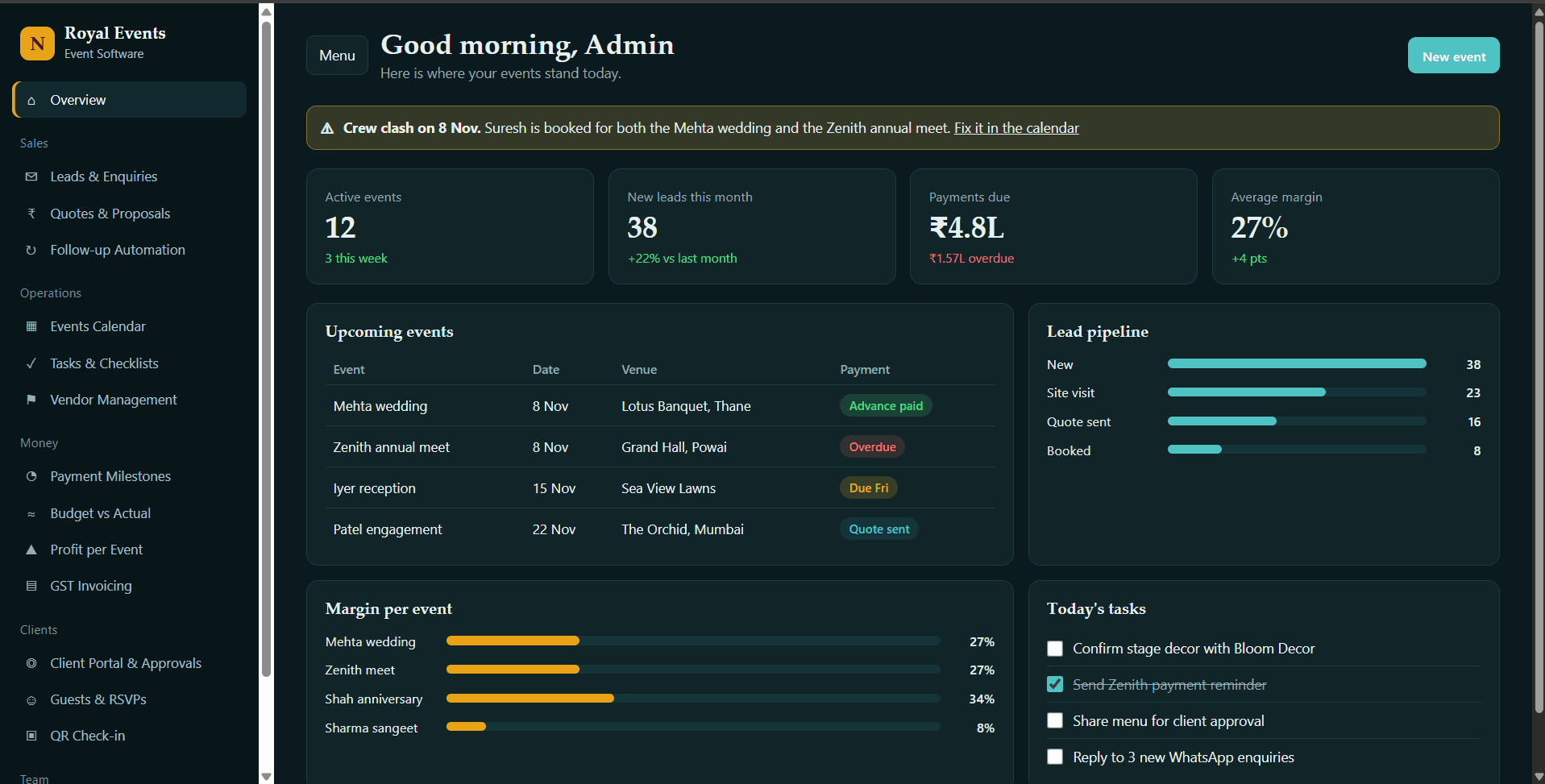
Week one, leads and quotes. Week three, vendor payments and payment milestones. The ₹1.57 lakh overdue figure in the screenshot is what turns up the first time every invoice sits in one place. It was always there. Nobody had added it up.
| Measure | Before | After |
|---|---|---|
| Time to send a quote | 2 days | 40 minutes |
| Overdue client payments found on day one | Unknown | ₹1.57 lakh |
| Coordinator hours a week spent reconciling vendor payments | 9 hours | Under 2 |
| Crew double-bookings found before the event | On the day | At booking |
Should you use Eventbrite, Cvent or a custom event management system?
Use Eventbrite or Cvent if you sell tickets or run large conferences. Use a custom system if you run events for clients and your problems are vendors, budgets and invoices. Stay on Excel and WhatsApp if you do fewer than five events a month. Honestly.
| Custom (Nexona Labs) | Eventbrite / Cvent | Excel + WhatsApp | |
|---|---|---|---|
| Built for | Planners, wedding companies, caterers and agencies running the business side of events. | Selling tickets and registering attendees for conferences and public events. | Anything, which is the problem. Every planner builds a different sheet. |
| Pricing | From ₹19,000, one time. No per-user fee. | Eventbrite takes a fee per paid ticket. Cvent is quote-based, usually on annual contracts. | Free. You pay in coordinator hours and double payments. |
| Vendor payments and budgets | Advances, balances and budget vs actual per event. | Not the focus. Budgeting is usually basic or an add-on. | Possible, if one person maintains it and never leaves. |
| GST invoicing | Built in, with Tally and Zoho Books sync. | Not built for Indian GST invoicing. | Typed by hand at month end. |
| Official WhatsApp Business API for leads, reminders and alerts. | Email-first. | Twenty groups, no record. | |
| Fits how you work | Built around your stages, approvals and rate cards. | You adapt to the product. | Fits perfectly, until a second person edits it. |
| Who owns the data | You. Code and database. | You rent access. | You, scattered across laptops. |
Do I need an ERP or a CRM for my event company?
Probably both, in one system. A CRM handles the front half: enquiries, follow-ups, site visits, quotes. An ERP handles the back half: vendors, crew, inventory, budgets, invoices.
Buying them separately is how a booked lead ends up retyped into a second tool, by a coordinator, at 11 pm. Under about 50 events a year, a CRM with quotes and payment tracking is enough. Past that you want the back half too, and you want it joined to the front.
Already have a CRM you like? Fine. We can build only the back half and connect it. See how we approach custom business management software more generally.
Marriage planner software and wedding CRM, in one
Indian weddings are five events wearing one name. Haldi, mehendi, sangeet, wedding, reception, each with its own venue, vendors and guest count.
The wedding CRM side tracks the enquiry from the first Instagram DM to the signed quote. The planner side splits the wedding into functions, each with its own budget, vendor list and checklist. Families approve the menu and decor through a client portal instead of a forwarded PDF with fourteen voice notes attached. Guests RSVP by link, rooms get allotted, and the caterer gets a live headcount, not a guess made on Tuesday.
What should catering management software do?
Turn a headcount and a menu into a purchase list, a staff roster and an invoice, without three people redoing the maths.
Menus are built from recipes with per-plate costs, so a 700-plate quote shows its margin before it goes out. Final RSVP numbers flow into the kitchen’s raw material list. Service staff are rostered per event. Advances and balances are tracked per function, and GST invoices go out with the right rate for outdoor catering. If you cater for planners, not direct, they can see their orders in a portal of their own.
Does it work for corporate agencies and production houses?
Yes. The spine is the same: enquiry, quote, vendors, money. What changes is the part that hurts most.
Corporate event agencies
Procurement wants its PO number on every invoice and bounces anything that does not match the approved quote to the rupee. Quotes, POs and invoices sit on one record, so they match. Offsites, dealer meets and product launches each get their own checklist template.
Decor and production houses
Your stock is the business: trusses, LED panels, 300 chiavari chairs, a mandap frame that lives in Bhiwandi. Inventory is booked per event with dispatch and return, so the same LED wall cannot go to two venues on one night.
Does it work with WhatsApp, Razorpay, Tally and Zoho Books?
Yes, all four. Your clients keep talking on WhatsApp, pay through Razorpay links, and your accountant keeps working in Tally or Zoho Books. The system sits in the middle.
WhatsApp Business API
Enquiries become leads. Quotes, RSVP nudges and payment reminders go out on WhatsApp.
Razorpay
Payment links on every milestone. Paid status updates on the event by itself.
Tally Prime
Invoices, receipts and vendor bills synced in. Your accountant stays in Tally.
Zoho Books
Same sync, for teams that keep their books in Zoho instead.
GST e-invoicing
IRN and QR code from the invoice screen for clients that need e-invoices.
Excel import
Your existing leads, vendors and rate cards come across on day one.
How much does event management software cost in India?
₹19,000
That gets your first core module live, usually lead tracking and quotations, built around how your team already works. Not a template with your logo on it.
The full system is scoped after a free workflow audit and each stage is quoted before we start it. No per-user licence. Hire six more coordinators for wedding season and the bill stays where it is.
| What | Price | Time |
|---|---|---|
| First core module (usually leads + quotations) | From ₹19,000 | 2–3 weeks |
| Full system: all seven modules + client portal | Quoted after the audit | 6–10 weeks |
| Hosting | From ~₹1,000 / month | Paid at cost |
| Per-user licence | ₹0 | Add staff freely |
What moves the price up
How many modules
₹19,000 gets one module live. Each one after that is scoped and quoted before we start it.
Integrations
WhatsApp Business API, Razorpay, Tally and Zoho Books are each a real piece of work.
Guest-facing parts
RSVP pages, QR passes and a check-in scanner for 1,500-guest weddings need more care than an internal screen.
The state of your data
One clean vendor sheet moves in an hour. Six years of WhatsApp-forwarded rate cards take longer.
How big is the Indian events market?
Big, growing fast, and run on too many disconnected tools. Three figures worth knowing, from people who counted.
46 lakh
weddings in the 1 Nov – 14 Dec 2025 season, driving about ₹6.5 lakh crore in trade. Catering took around 10% of wedding spend and event management around 5%.
$59.2 billion
projected size of India’s experience economy by 2030, up from $32.2 billion in 2024, growing 16–18% a year. Organised events already support over one crore jobs.
70%
of event planners said the lack of integration between their event tools was their biggest challenge. 83% used more than one provider.
Put the first and last together. Lakhs of events a season, and most planners juggling tools that don’t talk to each other. That gap is the whole reason this page exists.
Event management software questions, answered straight
What is the best event management software in India for a small event planner?
Depends what you sell. If you sell tickets, use Eventbrite or Zoho Backstage. If you run weddings, corporate events or catering, the hard part is vendors, budgets and GST invoices, and ticketing tools don't touch that. For those planners a custom event management system usually fits better, and ours starts at ₹19,000 for the first module.
How much does event management software cost in India?
Custom event management software from Nexona Labs starts at ₹19,000 for one core module, usually lead tracking and quotations. A full system — leads, quotes, vendor payments, budget vs actual, guest RSVPs, check-in and GST invoicing — is scoped after a free workflow audit and quoted before we start. No per-user licence. Hosting is paid at cost, from about ₹1,000 a month.
Can I run my event business on Excel and WhatsApp?
Yes, up to about four or five events a month. Past that, the same vendor invoice sits in two WhatsApp groups, someone pays it twice, and the costing sheet has three versions nobody trusts. That is usually the point where a single event management system pays for itself.
What is the difference between event planner software and a wedding CRM?
A wedding CRM handles the sales side: enquiries, follow-ups, site visits, quotes. Event planner software covers everything after the booking too: vendors, crew, budgets, guest lists, check-in and invoices. Most Indian wedding planners need both, and they work better as one system so a booked lead becomes the event without retyping it.
Can event management software create GST invoices?
Ours does. GST invoices, credit notes and payment receipts come straight from the event record, with your GSTIN, HSN/SAC codes and the right CGST/SGST or IGST split. It can push them into Tally or Zoho Books so your accountant keeps working where they already work.
Does it work with WhatsApp?
Yes, through the official WhatsApp Business API. Enquiries from WhatsApp land as leads, quotes and payment reminders go out as WhatsApp messages, and your team gets task alerts there. Meta charges per message; we pass that through at cost.
Is Cvent or Eventbrite good for Indian wedding planners?
Not really. Cvent is built for large corporate conferences and is priced on annual contracts. Eventbrite is a ticketing platform that takes a fee per paid ticket. Neither handles vendor advances, a mandap decorator’s balance payment or a GST invoice to the bride’s father. They are good products, built for a different job.
How long does it take to set up custom event management software?
The first module is usually live in two to three weeks. A full system takes six to ten weeks and arrives in stages, so your team is using real screens from the first month instead of waiting for a big launch.
Can my team use it on their phones at the venue?
Yes. It runs in any phone browser and can be installed as an app on Android and iOS. Coordinators tick off checklists, scan guest QR codes at check-in and log a vendor payment from the venue, not after they get back to the office.
Do I own the software and my data?
Yes. The source code, the database and the documentation are yours. Host it where you like, and hand it to another developer later if you want. You are not renting access to your own client list.
Want the longer version? Read how to manage and scale an event management business.

Written by
The Nexona Labs team
A Mumbai software studio building custom ERPs, CRMs and event management systems for Indian businesses. 50+ systems shipped. Last updated .
Get a free workflow audit
Thirty minutes. Walk us through how one event moves from enquiry to final invoice today, and we will show you where the money and the hours leak, what we would build first, and what it costs. No deck.